Bad Mangal in Lal Kitab Meaning Symptoms Venus and Mars Combination & Remedies

Bad Mangal is a condition discussed in Lal Kitab where the energy of Mars becomes troublesome because of certain planetary combinations or influences in the horoscope. It does not mean that Mars is always negative. Rather, the way Mars combines with other planets and houses determines how its energy may manifest in a person's life.
One important combination associated with Bad Mangal is Venus + Mars. To know more about Bad Managl Read Here.
Mars represents energy, courage, action, aggression and assertiveness, while Venus represents relationships, comfort, attraction, wealth, enjoyment and family harmony. When these two very different energies combine negatively, their interaction can create situations involving over-attachment, relationship conflicts, instability of wealth, family disagreements and problems connected with in-laws.
However, this combination should not be judged in isolation.
Jupiter, Saturn, Mercury, Ketu, the house involved and the overall horoscope can significantly change the result.
That is why in Lal Kitab, the real question is not simply:
“Do I have Venus and Mars together?”
The more important question is:
“How is the Venus–Mars combination behaving in my horoscope?”
What Are the Signs of Bad Mangal?
If Venus and Mars are forming a problematic combination, some of the following patterns may become noticeable in life:
1. Difficulty Getting Your Point Across
The person may become very insistent about making others accept their opinion. Discussions can easily turn into arguments because the Mars energy wants to assert itself, while Venus wants things to happen according to personal preferences.
2. Not Listening to the Life Partner
One noticeable manifestation can be difficulty accepting the partner's perspective.
Instead of cooperation, the relationship can become a situation where both people want to establish their own point of view.
3. Family Relationships May Become Difficult
The person may experience repeated disagreements within the family, particularly when money, relationships, expectations or personal choices are involved.
4. Money Does Not Remain Stable
One of the important observations associated with a negative Venus–Mars influence is that money may come but fail to provide lasting stability.
There can be spending connected with comfort, relationships, family matters or personal desires.
5. Lack of Interest in Religious or Spiritual Activities
A difficult expression of the combination may also reduce the person's inclination toward religious activities, pilgrimage, traditional family practices or spiritual participation.
These signs should not be treated as a diagnosis of Bad Mangal by themselves. They are patterns to observe alongside the planetary combination and the rest of the horoscope.
Venus + Mars: An Important Bad Mangal Combination
One of the important combinations considered while analysing Bad Mangal is Venus and Mars together.
When this combination functions negatively, it can show:
- Excessive attachment
- Instability in wealth
- Problems involving in-laws
- Relationship disagreements
- Difficulty maintaining family harmony
- Conflict between personal desires and family expectations
For example, if a person repeatedly experiences a situation where money is available but does not remain stable, or where financial matters continuously create family conflict, it becomes worthwhile to examine the Venus–Mars combination in the horoscope.
Similarly, repeated disagreements with family members or in-laws can become another reason to examine whether Venus and Mars are creating a difficult influence.
Why Can Venus and Mars Create Bad Mangal?
The Venus–Mars combination brings together two fundamentally different types of energy.
Mars represents masculine, active, fiery and action-oriented energy.
Venus represents feminine, receptive, relationship-oriented and comfort-seeking energy.
When these energies work harmoniously, they can create strong attraction, motivation, stamina, creativity and the ability to build material resources.
But when they clash, the same intensity can turn into:
- stubbornness,
- excessive attachment,
- control issues,
- relationship friction,
- impulsive decisions,
- possessiveness,
- or difficulty balancing desire and responsibility.
From an Ayurvedic perspective, Venus is traditionally associated with Kapha-oriented qualities, while Mars carries strong Pitta-oriented qualities. Their interaction can therefore be viewed symbolically as a combination of heaviness/fluidity and heat/activity.
This should be understood as a traditional interpretive framework, not as a medical diagnosis. Astrological combinations should not be used to diagnose conditions such as acne, reflux or joint disease.
When Does Bad Mangal Get Cancelled?
This is one of the most important points in understanding the Venus–Mars combination.
Venus + Mars does not automatically mean negative results.
If Jupiter aspects the Venus–Mars combination, the difficult expression can be significantly reduced or cancelled according to the Lal Kitab interpretation being used.
Jupiter brings qualities such as:
- wisdom,
- guidance,
- family values,
- stability,
- spirituality,
- higher knowledge,
- and a broader perspective.
Therefore, when Jupiter influences Venus and Mars, the same combination can produce much more constructive results.
Possible positive manifestations include:
- Better family support
- Greater financial stability
- Better relationship with family
- Interest in religious activities
- Participation in family traditions
- Improved fortune
- Better ability to handle relationship and financial matters
So the same Venus–Mars combination can behave very differently depending on the planetary influences surrounding it.
What If Saturn Also Aspects Venus and Mars?
There is another important layer.
If Saturn aspects the Venus–Mars combination, the results can become quite different.
Saturn may bring restriction, delay, seriousness, pressure and responsibility into the combination.
Therefore, a Venus–Mars combination receiving Saturn's influence may show the opposite type of experience from the Jupiter-supported combination, particularly when the rest of the horoscope also supports difficulty.
But there is an interesting observation:
What if BOTH Jupiter and Saturn influence Venus and Mars?
According to this interpretive framework, the combination can produce very interesting and potentially strong results.
Jupiter provides wisdom and expansion, while Saturn provides discipline, structure and responsibility.
Together, these influences can help the intense Venus–Mars energy become more controlled and productive.
This is why one should never label Venus + Mars as simply “good” or “bad” without examining the complete horoscope.
Can Mercury and Ketu Also Reduce Bad Mangal?
Another important factor in this interpretation is the condition of Mercury and Ketu.
If Mercury and Ketu are well placed and supportive in the horoscope, some of the negative manifestations associated with a difficult Venus–Mars combination may be reduced.
This can particularly help with issues such as:
- money instability,
- family disagreements,
- relationship problems,
- excessive attachment,
- and difficulty handling personal desires.
On the other hand, if Mercury and Ketu themselves are adversely placed, the negative side of the Venus–Mars combination may become more noticeable.
Therefore, these planets should also be examined before reaching a final conclusion.
Venus + Mars in Different Houses
The house in which Venus and Mars combine can completely change the way this energy manifests.
Venus + Mars in the 2nd House
This placement can produce interesting results connected with family wealth and in-laws.
The person's in-laws may be financially well placed, and financial benefits or resources coming through the in-laws may be enjoyed.
This combination can also be associated with healthy and prosperous outcomes for the next generation, depending on the rest of the horoscope.
Venus + Mars in the 3rd House
The third house connects with siblings, communication, courage, skills and efforts.
A positive expression of Venus and Mars here can bring:
- Financial help from siblings
- Strong support from brothers and sisters
- Benefits through communication
- Financial gains through personal skills
- Helpful connections with neighbours or the immediate environment
However, the same placement can show relationship complications when Venus–Mars becomes negative.
The person may struggle with commitment in relationships, which can eventually affect marital harmony and finances.
So the complete horoscope is important.
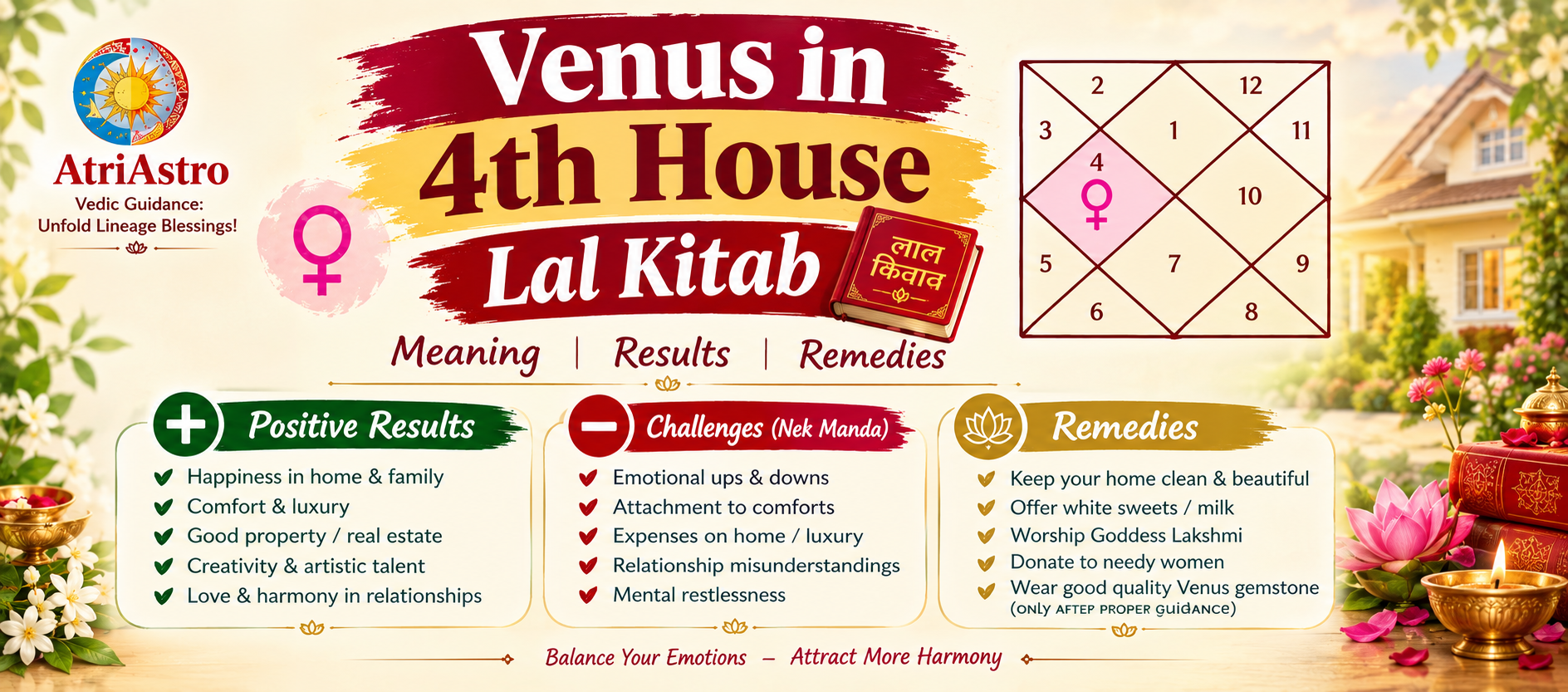
Venus + Mars in the 4th House
The fourth house connects strongly with home, family, emotional security, property and the maternal side of the family.
A difficult Venus–Mars combination here can create:
- Problems with in-laws
- Particularly difficult equations with the brother-in-law
- Financial losses
- Issues connected with the maternal family
- Excessive attachment to money and material comforts
- Over-indulgence
The underlying issue can become an excessive focus on money, comfort and enjoyment, which disturbs the balance between Venus and Mars.
As the combination becomes more strained, disagreements can extend into relationships with family members and in-laws.
Venus + Mars in the 8th House
The 8th house brings a very different dimension to Venus–Mars.
A person may sometimes feel compelled to go against family values or established family expectations to create their own path.
This can result in:
- Family contradictions
- Ideological disagreements
- Conflict with established traditions
- Difficulty controlling anger
- Strong emotional reactions
There can also be another behavioural expression.
The person may develop a habit of focusing heavily on the negative side of other people or situations.
At work, they may notice what is wrong with everyone else but find it difficult to acknowledge their own shortcomings.
They may praise themselves while repeatedly criticising colleagues, organisations or people around them.
This excessive pattern of criticism can itself become one of the areas that needs correction.
The practical lesson is simple:
When you constantly search for faults in others, you may unknowingly strengthen the difficult side of the Venus–Mars combination.
Venus + Mars in the 9th House
Venus and Mars in the ninth house can create a different set of relationship and responsibility-related themes.
The person may naturally take on a guiding or elder-sibling-like role within relationships or family circumstances.
At the same time, attention may be required toward the spouse's wellbeing and the quality of the marital relationship.
One challenge can be excessive expectations from relationships.
The person may create a mental checklist of what a partner should be like, leading to dissatisfaction when reality does not match those expectations.
Therefore, relationship expectations need to remain realistic.
Venus + Mars in the 10th House
The 10th house brings career, reputation, social standing and professional life into the picture.
One distinctive Lal Kitab observation associated with Venus–Mars here relates to siblings and wealth.
Siblings may become more financially prosperous than the native.
However, this should never be used as the only basis for judging the person's wealth or status.
The 2nd house and the planet placed there must also be examined before making a final prediction about finances.
An interesting in-law connection
This placement also has an interesting observation regarding in-laws.
If the brother-in-law possesses depth of knowledge, understands traditional philosophy and follows meaningful traditions, while the father-in-law has a broad and progressive perspective, their support can help the person establish and maintain:
- Career position
- Social reputation
- Professional stability
- Standing within society
Thus, the in-laws can indirectly contribute to the person's career growth and social position.
Venus + Mars in the 7th House
The seventh house is strongly connected with marriage, partnerships and relationships.
According to the interpretation you are following, Venus–Mars here can produce strong material and family-related benefits.
It may indicate:
- Financial abundance
- Benefits connected with agriculture or food
- Good quality food and comforts
- Financial stability
- Happiness through children and grandchildren
- A prosperous family environment
This is a good example of why Venus + Mars should not automatically be called Bad Mangal.
The same planetary combination can give constructive results when its overall condition is supportive.
So, Is Venus + Mars Always Bad Mangal?
No.
This is perhaps the most important point of the entire discussion.
A Venus–Mars combination can show challenging results when the combination is negatively influenced.
But when Jupiter supports it, or when other favourable planetary conditions modify it, the same combination can become productive.
It can support:
wealth + family support + relationships + stamina + material stability + religious inclination.
Therefore, the correct approach is not:
“Venus and Mars are together, so I have Bad Mangal.”
The correct approach is:
“Venus and Mars are together. How are they placed, which house are they in, who aspects them, and what other planets are influencing their results?”
How to Strengthen the Positive Side of Venus–Mars
Since Jupiter is one of the important planets that can help reduce the difficult expression of this combination, the remedy approach should focus on Jupiter-like behaviour and guidance.
Traditional supportive practices include:
- Respecting elders
- Seeking guidance from a father figure or mentor
- Taking blessings by touching the feet of elders
- Listening to the advice of one's parents and experienced people
- Reading good and meaningful books
- Developing respect for knowledge and wisdom
- Participating in constructive religious or spiritual activities
The purpose is not to perform a remedy blindly.
The deeper principle is to strengthen the qualities represented by Jupiter—wisdom, respect, guidance, ethics and a broader perspective.
Bad Mangal in Lal Kitab: The Key Takeaway
Bad Mangal is not simply about having Mars in a particular house.
It is about understanding how Mars behaves within a specific planetary environment.
The Venus–Mars combination is an important example. When it becomes difficult, it may show themes involving relationships, money, family disagreements, in-laws, attachment and excessive criticism.
But Jupiter can change the expression considerably.
Mercury and Ketu can also play a role, while Saturn may modify the result in another direction.
Therefore, before concluding that someone has Bad Mangal, always examine:
- The Venus–Mars combination
- The house where it occurs
- Jupiter's influence
- Saturn's influence
- Mercury and Ketu
- The 2nd house for wealth and family
- The 7th house for relationships
- The overall planetary condition
In short:
Bad Mangal is not a label to fear. It is a pattern to understand.
And once the pattern is understood, the purpose of Lal Kitab is not merely to predict the problem—it is to understand how the energy can be corrected and used constructively.