Sun in Lal Kitab
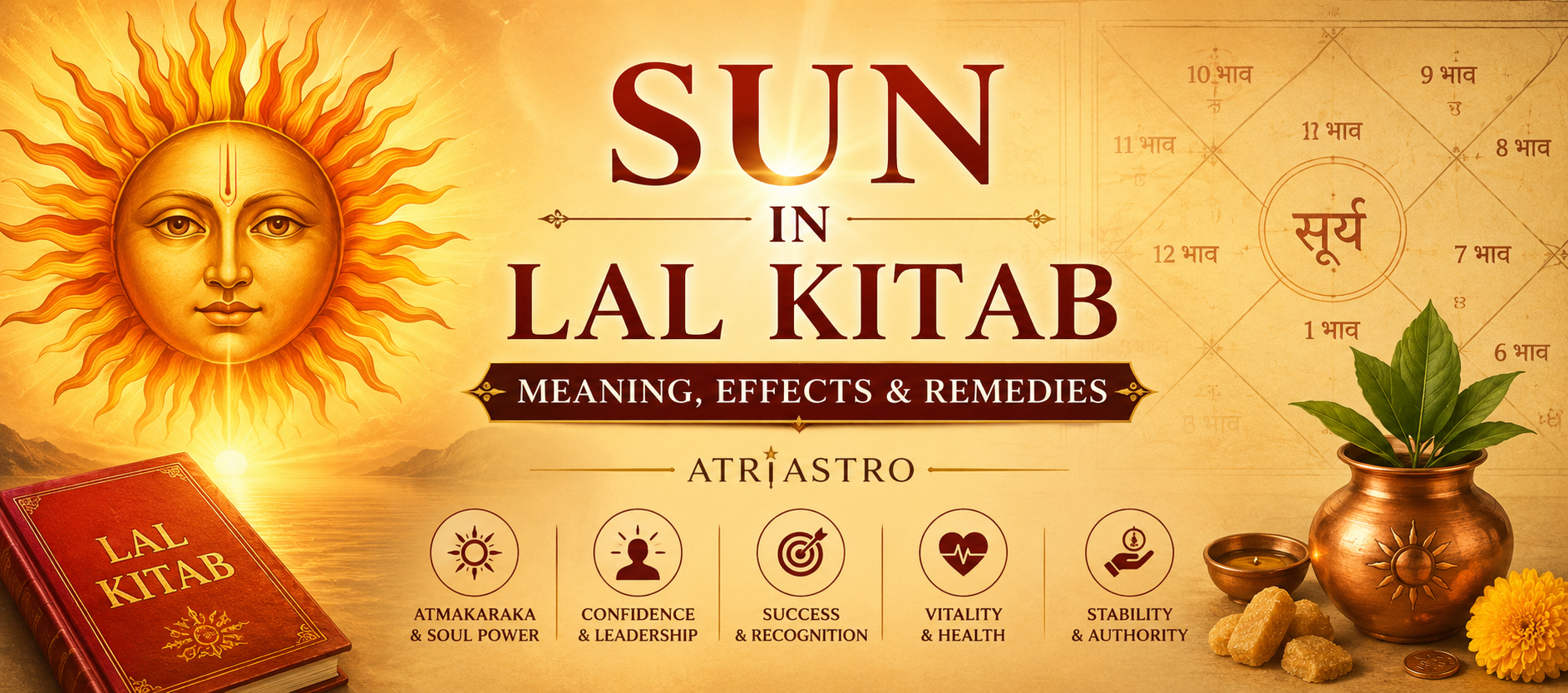
In Lal Kitab, every planet is understood not only through its astrological qualities but also through its relationship with houses, other planets, everyday objects, and symbolic principles. The Sun holds a particularly important position because it represents identity, authority, vitality, self-respect, father, recognition, and the ability to establish one's place in the world.
Understanding the rules of the Sun in Lal Kitab helps an astrologer look beyond conventional planetary interpretations and explore how the Sun behaves when it occupies different houses or interacts with other planetary energies.
The Basic Nature of the Sun in Lal Kitab
The Sun is the ruler of Leo and naturally represents leadership, confidence, individuality, authority, and the inner strength of a person. Its energy is fiery, direct, illuminating, and powerful.
In Lal Kitab, the first house is considered the Pakka Ghar (fixed or permanent house) of the Sun. This connection is significant because the first house represents the self, personality, physical identity, confidence, and the way an individual expresses themselves in the world.
A strong Sun can support qualities such as:
-
Leadership and authority
-
Self-confidence
-
Recognition and reputation
-
Strong individuality
-
Decision-making ability
-
Personal dignity and self-respect
However, the Sun's results are always influenced by the house it occupies and the planets associated with it.
Friends and Supportive Planets of the Sun
According to the Lal Kitab framework, Jupiter, Mars, and Moon are considered supportive friends of the Sun.
Each of these planets contributes differently to the Sun's expression.
Sun and Jupiter
Jupiter brings wisdom, knowledge, ethics, and guidance. When Jupiter supports the Sun, authority can be combined with wisdom and a sense of purpose.
Sun and Mars
Mars and the Sun both carry strong, active energy. Mars can support courage, determination, action, and leadership qualities associated with the Sun.
Sun and Moon
The Moon represents the mind and emotional nature, while the Sun represents identity and soul. A supportive relationship between these energies can help align inner confidence with emotional expression.
Mercury and the Strength of the Sun
Mercury holds a special role in understanding the Sun's functioning. In this framework, Mercury can strengthen the Sun by supporting intelligence, communication, analytical ability, and practical decision-making.
The Sun represents authority and direction, while Mercury helps translate that direction into thought, logic, speech, and action.
A well-supported Mercury can therefore help a person express the Sun's confidence through intelligence and effective communication.
Challenging Planetary Relationships for the Sun
In Lal Kitab interpretation, certain planetary energies can create challenges for the natural expression of the Sun. These include:
-
Saturn
-
Rahu
-
Ketu
-
Venus
These relationships should not be interpreted as automatically producing negative results. Lal Kitab astrology places great importance on the house involved and the overall planetary environment.
The key question is not simply, Which planet is sitting with the Sun?
The deeper question is:
Which area of life is represented by that house, and how are the two planetary energies interacting within that area?
Understanding Planetary Conflict Through Symbols
One of the interesting aspects of Lal Kitab is its symbolic method of explaining planetary relationships.
Planets are connected with particular objects, materials, elements, and everyday substances. These symbolic associations are often used to understand whether two planetary energies naturally support or disturb one another.
For example, the Sun is associated with fire and copper, representing heat, intensity, authority, and transformation. Venus represents softer qualities such as beauty, relationships, comfort, fertility, and creativity.
The symbolic difference between intense solar energy and the delicate, creative nature of Venus is important in Lal Kitab interpretation.
This can be understood through the idea of fertility and excessive heat. Fertile soil has the potential to nurture seeds, grass, and flowers. But when soil is excessively burnt, its natural ability to support growth may be disturbed.
Similarly, when a highly intense solar influence dominates delicate creative energy, the natural ease associated with relationships, creativity, or reproduction may face challenges.
This is a symbolic principle used to understand planetary interaction rather than a standalone rule for predicting every horoscope.
Sun and the Fifth House in Lal Kitab
The fifth house is associated with several important areas of life, including:
-
Creativity
-
Intelligence
-
Love and romance
-
Children
-
Personal expression
-
Emotional attachments
When analysing the Sun's relationship with the fifth house, Lal Kitab practitioners pay close attention to planets that may alter the natural expression of these areas.
The fifth house can bring out a person's unique ideas and creative intelligence. However, when conflicting planetary energies influence this house, the individual may experience differences in thinking, challenges in romantic relationships, or difficulties related to expressing creativity.
In some Lal Kitab interpretations, a person may develop ideas that differ significantly from parental expectations or social norms.
This does not necessarily mean that independent thinking is negative.
In fact, such a person may be highly creative and unconventional. However, the challenge can arise when their individual perspective creates conflict with family traditions, social expectations, or relationship dynamics.
Different Thinking and Relationship Challenges
One important principle to understand is that relationship challenges do not always arise because love is absent.
Sometimes, the challenge comes from two people having fundamentally different perspectives about life.
A person with a highly independent or unconventional mindset may find it difficult to fit into traditional expectations. This can affect romantic relationships, particularly when family values, social acceptance, personal freedom, and individual choices begin to conflict.
Therefore, when analysing love relationships in Lal Kitab, it is important to examine not only the presence of romance but also:
-
Compatibility of perspectives
-
Family involvement
-
Social expectations
-
Individual freedom
-
Planetary influence on the fifth house
When the Sun and Conflicting Energies Occupy the Same House
A conjunction should never be judged in isolation.
When the Sun shares a house with another planet, the astrologer should examine how their natural qualities interact and which life area is represented by that house.
The possible manifestation may relate to the specific significations of that house.
For example, depending on the house and the overall horoscope, challenges may be reflected in areas such as:
-
Creative expression
-
Relationships
-
Family harmony
-
Children
-
Personal confidence
-
Health and vitality
-
Social reputation
The house acts like a stage, while the planets act like characters. The final result depends on how those characters interact on that particular stage.
Why the House Matters More Than a Single Planetary Rule
A common mistake in astrology is to create absolute statements such as:
“This planet is always good here” or “This conjunction always gives negative results.”
Lal Kitab requires a more contextual approach.
The same planetary combination can produce different experiences depending on:
-
The house of placement
-
The Pakka Ghar of the planets
-
Friendly and challenging planetary relationships
-
The presence of supporting planets
-
The overall condition of the horoscope
Therefore, an astrologer should understand planetary principles first and then apply them to the individual chart.
Key Rules of the Sun in Lal Kitab
Here is a quick summary of the important principles:
| Factor | Lal Kitab Association |
|---|---|
| Zodiac Sign | Leo |
| Pakka Ghar | First House |
| Friendly Planets | Jupiter, Mars and Moon |
| Planet That Supports Its Strength | Mercury |
| Challenging Planetary Energies | Saturn, Rahu, Ketu and Venus |
| Metal Association | Copper |
| Core Nature | Authority, identity, vitality and self-respect |
Final Thoughts
The Sun in Lal Kitab is not simply a planet representing power or authority. It represents the core identity of an individual and the way a person carries their confidence, dignity, and purpose into the world.
Its results change according to the house it occupies and the planetary energies surrounding it.
The symbolic approach of Lal Kitab teaches us an important lesson: planetary combinations should be understood through their natural qualities and interactions rather than through isolated rules.
A strong astrological interpretation does not come from memorising that a particular combination is good or bad. It comes from understanding why two planetary energies interact in a particular way and which area of life is affected by that interaction.
That is where the real depth of Lal Kitab interpretation begins.