Tithi
Can Your Birth Tithi Explain Your Emotional Patterns?
Have you ever wondered why you find it difficult to express your feelings, even with the people closest to you?
Why do some people handle love, criticism, stress, and relationship problems with ease, while others struggle with the same situations?
And have you ever thought that your Birth Tithi could be connected to these emotional patterns?
In Vedic Astrology, Tithi is more than just a lunar day in the Panchang. It represents the relationship between the Sun and Moon and can provide another layer of understanding about our emotional nature, relationships, decision-making, and response to life's situations.
But there is an important point to understand: there is no Tithi that is completely good or bad. Every Tithi has both positive and challenging qualities. Which side becomes more active in your life depends on your complete horoscope, the Tithi Lord, its relationship with your Ascendant, Moon and Sun, planetary strength, circumstances, and running Dasha.
So, before asking “Which Tithi is good?”, let's understand what your Tithi actually represents and how it can influence different areas of your life.
What does tithi mean in astrology?
Tithi is the time required for the longitudinal difference between the Sun and Moon to increase by 12°.
A Tithi is one-thirtieth of a synodic lunar month, defined by a 12° increase in the angular (longitudinal) distance between the Moon and the Sun.
In formula form:
Tithi = (Longitude of Moon − Longitude of Sun) ÷ 12°
Since the angular difference completes 360°, there are:
360° ÷ 12° = 30 Tithis
30 Tithis and Longitudinal Difference
|
Tithi |
Lunar Day |
Sun–Moon Longitudinal Difference |
|
शुक्ल प्रतिपदा (Pratipada) |
1st lunar day |
0°–12° |
|
शुक्ल द्वितीया (Dvitiya) |
2nd lunar day |
12°–24° |
|
शुक्ल तृतीया (Tritiya) |
3rd lunar day |
24°–36° |
|
शुक्ल चतुर्थी (Chaturthi) |
4th lunar day |
36°–48° |
|
शुक्ल पंचमी (Panchami) |
5th lunar day |
48°–60° |
|
शुक्ल षष्ठी (Shashthi) |
6th lunar day |
60°–72° |
|
शुक्ल सप्तमी (Saptami) |
7th lunar day |
72°–84° |
|
शुक्ल अष्टमी (Ashtami) |
8th lunar day |
84°–96° |
|
शुक्ल नवमी (Navami) |
9th lunar day |
96°–108° |
|
शुक्ल दशमी (Dashami) |
10th lunar day |
108°–120° |
|
शुक्ल एकादशी (Ekadashi) |
11th lunar day |
120°–132° |
|
शुक्ल द्वादशी (Dwadashi) |
12th lunar day |
132°–144° |
|
शुक्ल त्रयोदशी (Trayodashi) |
13th lunar day |
144°–156° |
|
शुक्ल चतुर्दशी (Chaturdashi) |
14th lunar day |
156°–168° |
|
पूर्णिमा (Purnima) |
15th lunar day |
168°–180° |
|
कृष्ण प्रतिपदा (Pratipada) |
16th lunar day |
180°–192° |
|
कृष्ण द्वितीया (Dvitiya) |
17th lunar day |
192°–204° |
|
कृष्ण तृतीया (Tritiya) |
18th lunar day |
204°–216° |
|
कृष्ण चतुर्थी (Chaturthi) |
19th lunar day |
216°–228° |
|
कृष्ण पंचमी (Panchami) |
20th lunar day |
228°–240° |
|
कृष्ण षष्ठी (Shashthi) |
21st lunar day |
240°–252° |
|
कृष्ण सप्तमी (Saptami) |
22nd lunar day |
252°–264° |
|
कृष्ण अष्टमी (Ashtami) |
23rd lunar day |
264°–276° |
|
कृष्ण नवमी (Navami) |
24th lunar day |
276°–288° |
|
कृष्ण दशमी (Dashami) |
25th lunar day |
288°–300° |
|
कृष्ण एकादशी (Ekadashi) |
26th lunar day |
300°–312° |
|
कृष्ण द्वादशी (Dwadashi) |
27th lunar day |
312°–324° |
|
कृष्ण त्रयोदशी (Trayodashi) |
28th lunar day |
324°–336° |
|
कृष्ण चतुर्दशी (Chaturdashi) |
29th lunar day |
336°–348° |
|
अमावस्या (Amavasya) |
30th lunar day |
348°–360° |
Tithi lord in astrology
Each Tithi is ruled by a particular planet, known as the Tithi Lord in astrology. In astrology, Tithi is also associated with the water element and the emotional dimension of life. Therefore, the condition and placement of the Tithi Lord can provide valuable insights into how a person experiences, expresses, and shares emotions in both personal and professional relationships.
The Tithi Lord's placement in the horoscope can give clarity about how comfortable a person is in expressing what they are going through with their parents, spouse, friends, family members, and other close relationships.
When the Tithi Lord is strong and well placed in the horoscope, it can support emotional harmony, healthy communication, and greater emotional stability. When the Tithi Lord is weak or afflicted, a person may experience emotional challenges, difficulty expressing feelings, emotional misunderstandings, or instability in relationships.
Tithi: Good or Bad? Understanding Tithi and Their Significance
When we talk about Tithi, good or bad, it is important to understand that no Tithi is completely good or completely bad.
Many of us ask, “Which Tithi is good?” Each Tithi has both positive and challenging traits. The complete horoscope analysis determines which side of the Tithi is more likely to become active in a person's life.
So, asking “Which Tithi is good?” is not a wrong question. However, to get the correct answer, we should also look at how that particular Tithi is connected with the rest of the horoscope.
The most important factor is the Tithi Lord, meaning the planet that rules that Tithi. We need to understand how the Tithi Lord is connected with the Ascendant, Moon sign, and Sun sign. Its house placement, sign, strength, aspects, conjunctions, and overall relationship with these important points can significantly change the way the Tithi works in a person's life.
This is why Tithi and their significance cannot be understood by looking at the Tithi alone.
Every Tithi Has Two Sides
Every Tithi carries both positive and challenging qualities. One side may show emotional strength, maturity, understanding, and the ability to handle relationships, while the other side may show emotional difficulties, confusion, attachment, or challenges in dealing with people.
- Which side becomes stronger depends on several factors, including:
- The condition and placement of the Tithi Lord
- Its relationship with the Ascendant
- Its connection with the Moon sign
- Its relationship with the Sun
- The houses influenced by the Tithi Lord
- Planetary aspects and conjunctions
- The person's circumstances and environment
- Learning ability and emotional maturity
- The running Dasha and planetary periods
Therefore, simply labelling a Tithi as good or bad can give an incomplete picture.
Which Tithis Are Auspicious?
When people search for good Tithi or which Tithis are auspicious, they are often looking for a general classification. Such classifications can be useful as a starting point, but they should not be treated as a final prediction for an individual.
A Tithi that is considered favourable in general may produce a completely different experience for a particular person depending on the condition of its lord and the complete horoscope.
Similarly, a Tithi that is traditionally considered challenging does not necessarily mean that the person will have a difficult life.
The Complete Horoscope Gives the Real Picture
The quality of a Tithi becomes clearer when we study it in the context of the entire horoscope.
For example, if the Tithi Lord is strongly connected with the Ascendant and receives supportive planetary influences, its positive qualities may become easier to express. If the same planet is under pressure or connected with challenging houses, the person may need more awareness and maturity to handle its energy.
This does not mean that one placement is permanently good and another is permanently bad. The results can change with circumstances, personal choices, learning, and the Dasha running at a particular time.
Therefore, for an accurate prediction, we should never judge a person's life or relationships only from their Tithi.
Tithi Is a Tool for Understanding, Not a Label
The real purpose of studying Tithi is to understand how a person responds to life and emotions, rather than putting them into a category of “good Tithi” or “bad Tithi.”
Every Tithi has something to teach. The positive side can show the person's natural strengths, while the challenging side can show areas where greater awareness, learning, and emotional maturity are required.
That is why Tithi and their significance should always be studied along with the Ascendant, Sun, Moon, Tithi Lord, planetary relationships, circumstances, and Dasha.
In short: Tithi does not decide the entire quality of your life. The complete horoscope decides how the qualities of your Tithi are expressed and experienced.
Tithi Significance in Relationships and Emotional Compatibility
Tithi and its significance give clarity on how our relationship and emotional health will be. The Tithi Significance in Relationships becomes particularly important when analysing emotional compatibility and the ability of a relationship to sustain itself through life's ups and downs.
The Tithi Lord, its strength, house placement, sign, and associations in the horoscope can provide clues about:
- How a person expresses emotions
- How comfortable they are sharing their feelings
- How they respond to emotional situations
- How they handle disagreements and misunderstandings
- What kind of emotional support they need from others
- How they develop emotional maturity over time
- Who or what can help them overcome emotional challenges
Therefore, Tithi can be considered an important factor when studying the emotional foundation of a relationship. It may provide insights into whether two people can understand each other's emotional needs and navigate challenges with greater maturity.
Tithi Lord and Emotional Maturity
The condition of the Tithi Lord can also offer clues about a person's emotional maturity and relationship behaviour.
A well-supported Tithi Lord may indicate greater emotional awareness and an ability to communicate feelings constructively. A challenged Tithi Lord may indicate areas where a person needs to develop better emotional boundaries, communication, patience, and self-awareness.
Understanding the Tithi Lord is therefore not only about predicting relationship challenges. It can also help identify how a person can overcome emotional difficulties and build healthier relationships.
Tithi Wise Birthday Celebration
Celebrating one's birthday according to the birth Tithi is traditionally considered a way of honouring the energy associated with one's Tithi and its ruling planet. A Tithi birthday is the most important as per your kundali.
A Tithi-wise birthday celebration is believed to help align you with the cosmic energies that were active at the time of your birth. It is traditionally considered a way of reconnecting with the divine energies of the planets and Nakshatras that were present when you entered this world.
By observing your birth Tithi, you can create a deeper connection with these celestial energies and seek their blessings, guidance, and positive influence in your life.
In this sense, your tithi birthday becomes a spiritual connection between you and the cosmic energies that were present at the time of your birth.
From an astrological and spiritual perspective, observing or celebrating the birth Tithi can be used as a practice for strengthening self-awareness, emotional maturity, and inner balance.
The purpose is to become more conscious of one's emotional patterns, develop a better understanding of others, avoid unintentionally hurting people, and build the emotional strength needed to protect oneself from unhealthy relationship dynamics.
Thus, understanding the Tithi Significance in Relationships can offer another layer of insight into emotional compatibility, communication, relationship maturity, and the way we connect with the people who matter most in our lives.
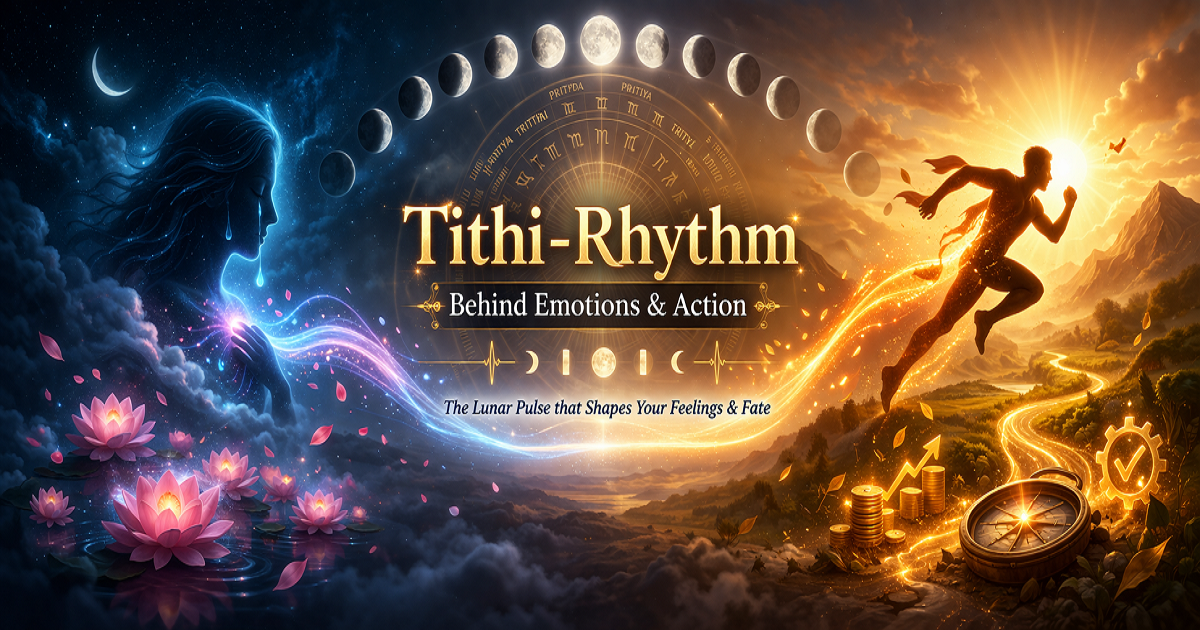
Tithi-Rhythm Behind Emotions & Action
Your Horoscope holds the Key to unlock your Destiny if you know on which Tithi you were born. Tithi is the Lunar Day, which is the divine relationship between the Sun and Moon.
- In Vedic Astrology, Tithi plays a significant role in your emotional health, love and romantic relationship.
- It also plays a significant role in your wealth and financial gain if the status of the planet is good and strong, which rules your Tithi. All our mood and emotional health are connected with Tithi.
Panchang and Tithi relationship:
Panchang has Five Limbs that is Tithi, Nakshatra, Karana, Vara and Yoga. These five important control the amount and status of five elements in our life.
- Tithi represent the water element. Whater element that rules our emotions, happiness and health in this present life.
- Nakshatra represents the air element. Air element that represents how we will think and execute those plans properly or face challenges due to complex thoughts.
- Karan represents the earth element. Planet which rules the Karna its placement in the horoscope, gives clarity whether you will attain stability in your career and life or not.
- Vaar stands for the weekday and rules the Fire Element in Panchang. The planet which rules your birth weekday, that is called Vaar plays a vital role to give you good health. Affliction to week lord in your horoscope can cause health issues regarding that area.
- Yoga represents the sky or the Ether Element. This element and its ruling planets in one’s horoscope give the ability to connect with everyone around you and approach the international connections as well.
Panchang shapes the pattern of your life through its five elements:
Yes, a big surprise that brings the clarity of what the mood of the planet was at the time of your birth, fix that mood of your soul, which you are carrying, is the planet that rules your Birth Tithi.
Your personal Panchang hold the Key that helps you unlock to know which Tithi you were born and which planet rules your Birth Tithi.
In-depth horoscope analysis based on the Tithi Lord placement will help you to understand how the planet is placed in which status, so that you can bring harmony to attain wealth in your life.
You might have heard many times or have asked what Tithi is today or what Tithi is tomorrow if you belong to Indian culture.
Even the best Tithi to conceive are also considered so that the next generation will have good health, not only the physical but also the emotional health, which plays a significant role in giving quality of life.
Indian Panchang- the calendar- where we follow the lunar and Solar relationship to execute any auspicious work and to perform tasks related to construction or marriage.
Tithi for festivals & celebration plays a significant role in celebrating that, where it’s the Tithi for Mahashivratri or the Tithi for marriage.
How is your Birth Tithi useful in the present Era?
- The Birth Tithi shows where you will perform best in your career. How you will handle the criticism and manage the stress will chalnnzle by the energy you are carrying with your Birth Tithi.
- Whether you are good at savings or have an impulsive approach can be analysed, and also the remedy can be decoded through the in-depth analysis of your Birth Tithi and its relationship with your wealth and income house, which is the second and eleventh house in your horoscope.
- All your hidden talent and activation of skills will be channelized with your Birth Tithi when you start doing the personalized remedy.
- Your Birth Tithi will help you to have rejuvenation in your love relationship. There will be support from your love partner if you are born on an auspicious Tithi.
- Even your social relationships and emotional health are chanazlied with the energy of the planet that rules your Birth Tithi. If you are born on Chaturdashi Tithi born
- How you will take decision that will be based on your Tithi and its ruling planet. A fast and risk-taking approach will be there if you are born with Ashtami Tithi. If you are born with Ashtami Tithi, you can do better in startups and trading.
The planet that rules your Tithi decides how your emotional life will be, which plays a strong subconscious role in shaping your destiny and attracting the people who will love and care about you.
The ruling planet of Tithi decides how long you will be able to sustain your love and marital life. It brings clarity and harmony to your relationship.
The total number of Tithis is 30, of which 15 are the waxing phase of the Moon and the remaining 15 are the waning phase of the Moon.
These two phases decide how much strength and water, which represent emotions, are present within your Moon Sign.
Frequently Asked Questions About Tithi in Vedic Astrology
Q: What is Tithi in Vedic Astrology?
A: Tithi is a lunar day calculated from the angular distance between the Sun and Moon. A new Tithi begins whenever this longitudinal difference increases by 12°. There are 30 Tithis in a complete lunar cycle, divided into 15 Shukla Paksha and 15 Krishna Paksha Tithis.
Q: What is the significance of Tithi in astrology?
A: Tithi represents the relationship between the Sun and Moon and is traditionally associated with emotional patterns and the water element. Its significance can be understood more deeply by studying the Tithi Lord and its connection with the Ascendant, Sun, Moon, houses, and other planets.
Q: What is a Tithi Lord in astrology?
A: The Tithi Lord is the planet that rules a particular Tithi. Its strength, house placement, sign, aspects, and relationship with the Ascendant, Sun, and Moon can influence how the qualities of the person's Birth Tithi are expressed.
Q: Is there a good or bad Tithi?
A: No Tithi is completely good or bad. Every Tithi has both positive and challenging qualities. The complete horoscope determines which qualities are more likely to manifest. The Tithi Lord's condition and its relationship with the Ascendant, Sun, Moon, and running Dasha are important factors.
Q: Which Tithis are considered auspicious?
A: Certain Tithis are traditionally considered more suitable for specific activities, but there is no universally auspicious Tithi for every purpose or every person. Muhurta and individual horoscope analysis should be considered before deciding whether a particular Tithi is favourable for a specific activity.
Q: What does your Birth Tithi tell you?
A: Your Birth Tithi can provide additional insight into emotional patterns, communication, relationships, decision-making, and how you respond to different situations. However, it should not be interpreted independently. The Tithi Lord and the complete horoscope provide a more meaningful picture.
Q: How does Tithi affect relationships?
Tithi can provide insights into emotional expression and relationship patterns. The Tithi Lord's placement and its relationship with the Ascendant, Sun, and Moon can help understand how comfortably a person expresses emotions, handles misunderstandings, and develops emotional maturity in relationships.
Q: Does Tithi affect emotional health?
A: In astrological interpretation, Tithi is associated with the emotional dimension of life and the water element. Its influence is studied along with the Moon and Tithi Lord to understand emotional patterns. However, Tithi alone should not be used to make conclusions about a person's mental or physical health.
