Why Laal Kitab is Red
What is Lal Kitab?
Lal Kitab is well known for its unique and practical remedies. It was written by Pt. Roop Chand Joshi Ji, and its basic principles are rooted in Vedic Astrology.
What makes Lal Kitab remedies different is their simple and practical approach. Lal Kitab Upay/ remedies are widely followed because they focus on correcting planetary influences through specific actions and remedies, which are traditionally believed to help bring desired results more quickly.
The real beauty of Lal Kitab is that its remedies go beyond gemstones, donations, or rituals. They help us understand the deeper connection between planetary energy, our behaviour, emotions, and everyday life.
Have you ever wondered why the color red holds such significance in Kitab Lal? Why Is Lal Kitab Called "Lal" (Red)? It Is More Than Just a Color.
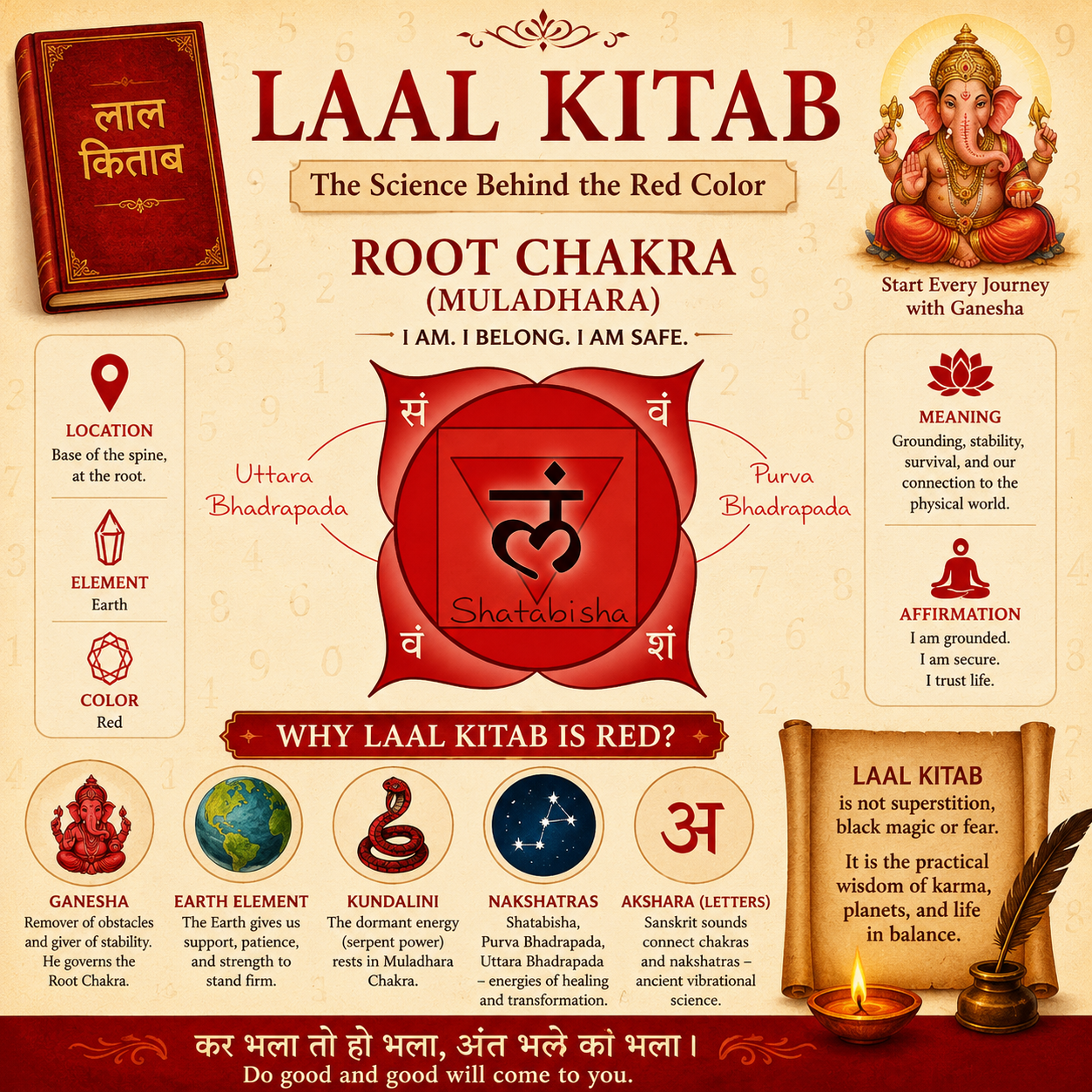
Lal Kitab is called “Lal” not merely because of its red cover. Red represents the Muladhara Chakra—the root and foundation of life, which is associated with the Earth element (Prithvi Tattva).
Mars (Mangal) is traditionally known as Bhumiputra—the son of Mother Earth, and Mars is also represented by the color red. Its energy is therefore symbolically connected with the grounding and foundational qualities of the Muladhara.
This deeper connection between Red, Earth, Muladhara, and Mangal helps explain why Lal Kitab is also described in its philosophy as the “Book of Mangal.”
Just as a strong building needs a strong foundation, Lal Kitab emphasizes grounding before moving toward higher spiritual knowledge. So, the “Lal” in Lal Kitab is more than a color—it represents the Earth, the root, and the energy from which transformation begins.
Many people believe Lal Kitab is called "Lal" simply because of its red cover.
Some even associate it with:
- Black magic
- Superstition
- Fear-based astrology
- Random rituals
- lal kitab totke
But if you study the philosophy behind Lal Kitab deeply, a very different picture emerges.
According to Pt. Roop Chand Joshi, only the red cover (Lal Surkh) is considered auspicious. Other colors were not recommended.
This statement was never meant to create blind belief.
Instead, it hints at a deeper spiritual science that connects color psychology, Vedic energy systems, chakras, planetary vibrations, Sanskrit letters, nakshatras, and human consciousness.
The red color is symbolic of the Muladhara Chakra (Root Chakra)—the foundation upon which every spiritual and material journey begins.
The First Rule of Any Spiritual Knowledge: Build a Strong Foundation
Imagine constructing a skyscraper.
Would you begin from the 20th floor?
Never.
You first strengthen the foundation.
Similarly,
before astrology,
before meditation,
before Kundalini,
before spiritual powers,
your root energy must become balanced.
Without grounding,
knowledge becomes confusion.
Power becomes ego.
Remedies become fear.
This is exactly why Lal Kitab begins from the root of life—not from complicated astrology.
Why the Root Chakra Matters
The Muladhara Chakra is located at the base of the spine.
It represents:
- Survival
- Stability
- Physical health
- Security
- Family
- Home
- Financial grounding
- Trust in life
Its natural color is Red.
This is the same red represented by Lal Kitab.
When this chakra is balanced,
a person naturally develops
- patience
- discipline
- confidence
- courage
- practical wisdom
When it is imbalanced,
the opposite appears.
People experience:
- unnecessary fear
- anxiety
- instability
- financial insecurity
- emotional imbalance
- lack of direction
No astrology remedy can completely help if the foundation itself remains unstable.
Why Is Lord Ganesha Connected with Lal Kitab?
Every auspicious work in Sanatana Dharma begins with Lord Ganesha.
This is not merely tradition.
It represents a spiritual principle.
Lord Ganesha governs:
- beginnings
- stability
- removal of obstacles
- grounding intelligence
These qualities perfectly mirror the Root Chakra.
The Muladhara Chakra is traditionally associated with Lord Ganesha because He symbolizes a stable foundation before higher spiritual growth.
In the same spirit, Lal Kitab emphasizes practical life, karma, and simple remedies that help restore balance before seeking higher knowledge.
Earth Element: The Hidden Meaning Behind Lal Kitab
Every chakra corresponds to one of the five elements.
Muladhara represents Earth (Prithvi Tatva).
Earth symbolizes:
- stability
- patience
- nourishment
- endurance
- responsibility
- balance
A tree cannot grow without deep roots.
Likewise,
a human cannot grow spiritually without inner grounding.
This is why Lal Kitab repeatedly emphasizes practical actions, ethical conduct, family responsibilities, charity, and disciplined living—principles that strengthen one's foundation.
Kundalini Begins Here
Many people think Kundalini awakening starts from meditation.
Actually,
according to yogic philosophy,
Kundalini rests in a dormant state within the Muladhara Chakra.
It is often symbolically described as a coiled serpent, representing dormant spiritual potential rather than something to be feared.
When the Root Chakra becomes balanced,
the upward journey of consciousness can unfold naturally.
Without grounding,
forcing higher spiritual practices may create emotional or psychological imbalance.
Lal Kitab's emphasis on simplicity and stability aligns with the idea that transformation begins from a balanced foundation.
The Nakshatra Connection: Shatabhisha, Purva Bhadrapada & Uttara Bhadrapada
One fascinating perspective shared by many practitioners links the Root Chakra with the energetic qualities of three nakshatras:
- Shatabhisha
- Purva Bhadrapada
- Uttara Bhadrapada
These nakshatras are traditionally associated with themes such as healing, transformation, introspection, and spiritual evolution. Different traditions may map chakras and nakshatras differently, so this relationship should be understood as one interpretive framework rather than a universally accepted rule.
Some researchers and practitioners also explore how Sanskrit seed sounds (Aksharas) connected with nakshatras may resonate with different energy centers in the body. While this area is rooted in traditional spiritual systems rather than modern scientific consensus, it offers an interesting lens through which to study Vedic symbolism.
Horoscope by Lal Kitab Is Not Black Magic
One of the biggest misconceptions is that Lal Kitab belongs to occult practices or black magic.
This misunderstanding often arises because its remedies are unique and symbolic.
However, Lal Kitab is fundamentally based on:
- karma
- planetary influences
- practical remedies
- self-discipline
- compassion
- ethical living
Its remedies are generally intended to harmonize one's relationship with life, actions, and circumstances rather than invoke supernatural control.
Why Pandit Roop Chand Joshi Preferred the Red Cover
Pandit Roop Chand Joshi's guidance that only the red (Lal Surkhi) cover is auspicious is often understood symbolically.
Red represents:
- Root Chakra
- Earth element
- stability
- beginning
- life force
- grounded consciousness
Rather than focusing only on the physical color, many practitioners interpret it as a reminder that the study of Lal Kitab should begin with inner balance and disciplined living.
My Personal Understanding
From my own study and experience, I have come to see the red color of Lal Kitab not as a random design choice but as a symbolic reminder.
When our foundation is unstable, we often seek quick remedies while overlooking the inner work needed to create lasting change.
The symbolism of the Root Chakra reminds us that spiritual knowledge becomes truly beneficial only when we cultivate stability, responsibility, humility, and balance in everyday life.
This perspective is my personal interpretation and should be understood alongside the traditional teachings of Lal Kitab and related spiritual systems.
What Modern Science Says About Color
Modern psychology has explored how colors can influence mood, perception, and behavior.
Red is commonly associated with:
- alertness
- vitality
- strength
- action
- confidence
While scientific research does not validate chakra systems in the same way that spiritual traditions describe them, many people find value in combining symbolic practices with mindfulness, meditation, and ethical living.
In this sense, the symbolism of Lal Kitab's red color can be appreciated as both a spiritual metaphor and a psychological reminder to stay grounded.
Final Thoughts
The true meaning of Lal Kitab's red color extends far beyond aesthetics.
Whether viewed through the lens of spirituality, symbolism, or personal practice, it points toward one central message:
A strong foundation comes before higher knowledge.
The Muladhara Chakra teaches stability.
The Earth element teaches patience.
Lord Ganesha teaches us to remove obstacles before beginning any journey.
Lal Kitab, in this interpretation, invites us to cultivate these same qualities so that astrology becomes a path of self-awareness rather than fear.
As the saying beautifully reflects:
"कर भला तो हो भला, अंत भले का भला।"
Good actions create good outcomes. When our foundation is balanced, our decisions, relationships, and spiritual growth are more likely to move in the right direction.
Frequently Asked Questions
Q: Is Lal Kitab called "Lal" only because of its cover?
A: Red color also carries symbolic meaning related to grounding, stability, and the Root Chakra, in addition to its traditional red cover.
Is there a scientific proof connecting Lal Kitab with chakras?
Q: There is no established scientific evidence directly linking Lal Kitab with the chakra system. The connection is a spiritual and symbolic interpretation based on yogic and Vedic traditions.
A: Why is Lord Ganesha associated with the Root Chakra?
In yogic tradition, Lord Ganesha symbolizes stability, wisdom, and the removal of obstacles, qualities traditionally associated with the Muladhara Chakra.
Q: Does Lal Kitab teach black magic?
A: No. Lal Kitab primarily focuses on karma, planetary influences, practical remedies, and ethical conduct. It is distinct from practices commonly described as black magic.
Q: Why is the Earth element important in Lal Kitab's symbolism?
A: The Earth element represents grounding, patience, and stability—qualities that support both practical life and spiritual development.
Q: Can balancing the Root Chakra improve life?
A: Many spiritual traditions teach that practices such as meditation, mindful living, physical grounding, and ethical actions can help cultivate a greater sense of stability and well-being. These practices complement rather than replace professional medical or psychological care when needed.