How to Prepare Makan Kundali in Lal Kitab Complete Step by Step Guide
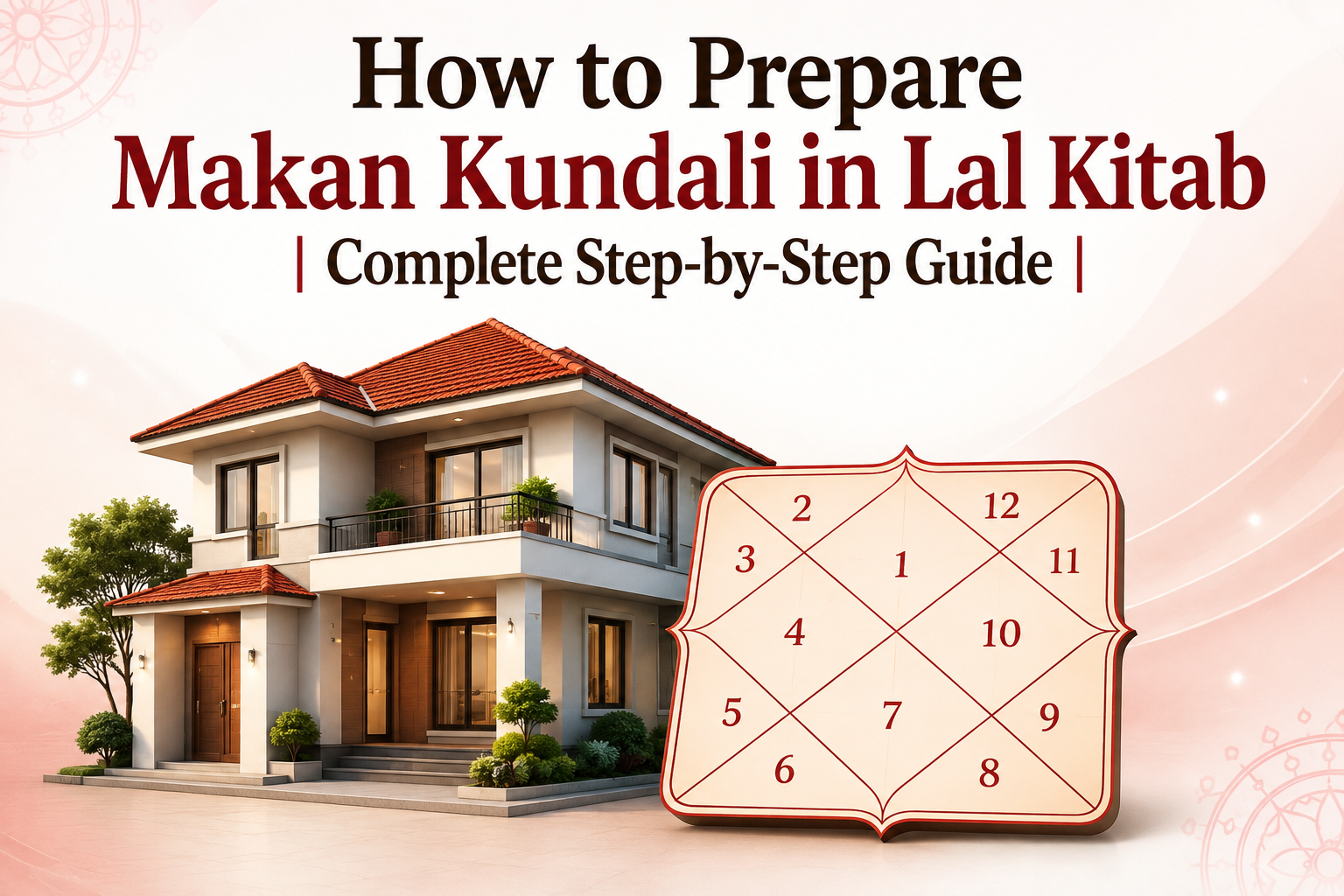
What You'll Learn in This Blog
By the end of this blog, you will learn how to:
- Understand what a Makan Kundali is and why it is important in Lal Kitab.
- Prepare a Vedic Birth Chart (Janma Kundali) as the starting point.
- Convert the birth chart into a Lal Kitab Kundali.
- Draw and prepare the Makan Kundali correctly.
- Mark all 12 directions and their ruling planets.
- Place the birth chart planets into the Makan Kundali.
- Analyze the relationship between the planet and the ruling planet of that direction.
- Identify friendly, neutral, and enemy planetary placements.
- Understand how directional energies influence different areas of life.
- Build a strong foundation for making accurate Lal Kitab predictions and remedies.
This give you a clear roadmap of what the blog covers before they dive into the detailed steps.
What is a Makan Kundali?
The word "Makan" means house.
In Lal Kitab, the horoscope is imagined as a house with twelve different sections. Every house represents a particular direction or area of the home and has its own ruling planet.
When a birth chart planet occupies one of these houses, it behaves like a guest entering someone else's home. Whether that guest feels comfortable or uncomfortable depends upon its relationship with the ruler of that house.
This unique approach makes Lal Kitab different from classical Vedic astrology.
Why is Makan Kundali Important?
Preparing the Makan Kundali helps an astrologer understand:
- The actual behavior of each planet.
- Which direction of the house becomes activated.
- Which direction becomes weak.
- Whether the planet is friendly with the ruler of that house.
- Why certain Lal Kitab remedies are recommended.
- How planetary energies influence different areas of life.
Without preparing the Makan Kundali, many Lal Kitab principles remain incomplete.
Step 1: Prepare the Vedic Birth Chart (Janma Kundali)
Every Lal Kitab analysis starts with the native's birth details.
You need:
- Date of Birth
- Time of Birth
- Place of Birth
Using these details, prepare the Vedic birth chart (Janma Kundali).
This chart gives the exact positions of all planets at the time of birth.
For example:
- Sun – 3rd House
- Moon – 7th House
- Mars – 10th House
- Mercury – 5th House
At this stage, simply note the planetary placements.
Step 2: Convert the Birth Chart into a Lal Kitab Kundali
The next step is to convert the Vedic horoscope into a Lal Kitab Kundali.
During this process:
- Focus on house placement rather than zodiac signs.
- Transfer all planets into their respective house numbers.
- Keep Rahu and Ketu in their respective houses.
- Ignore sign-based interpretations while performing Lal Kitab analysis.
Now your Lal Kitab horoscope is ready.
Step 3: Prepare the Makan Kundali
Now draw a blank twelve-house Lal Kitab chart.
Each house represents a fixed direction or area inside the symbolic house.
The following table should be marked on your Makan Kundali.
| House | Direction / Area | Ruling Planet |
|---|---|---|
| 1st House | East (E) | Sun |
| 2nd House | North-West (NW) | Moon |
| 3rd House | South (S) | Mars |
| 4th House | North-East (NE) | Jupiter |
| 5th House | East Wall | Sun |
| 6th House | North / North Wall | Mercury |
| 7th House | South-West (SW) | Rahu |
| 8th House | South Wall | Mars |
| 9th House | Brahm Sthan (Center) | Jupiter |
| 10th House | West (W) | Saturn |
| 11th House | West Wall | Saturn |
| 12th House | South-East (SE) | Venus |
This chart is known as the Makan Kundali.
It represents the energetic layout of the house according to Lal Kitab.
Step 4: Understand the Meaning of Every Direction
Each direction symbolizes a different energy.
For example:
- East represents identity, self-confidence, and vitality.
- North-East represents wisdom, blessings, and spiritual guidance.
- South relates to courage and initiative.
- South-East is associated with comfort, luxury, and material happiness.
- West indicates karma, discipline, and profession.
- Brahm Sthan represents the energetic center of the entire house.
When planets occupy these areas, they influence both life events and the corresponding directional energy.
Step 5: Place the Birth Chart Planets onto the Makan Kundali
Now transfer every planet from the Lal Kitab horoscope into the Makan Kundali.
Suppose your horoscope is:
- Sun – 1st House
- Moon – 4th House
- Mars – 8th House
- Mercury – 6th House
- Jupiter – 9th House
- Venus – 12th House
- Saturn – 10th House
- Rahu – 3rd House
- Ketu – 9th House
Place them into their respective houses.
Now the Makan Kundali becomes active.
Step 6: Compare the Planet with the Ruling Planet of that Direction
This is the most important step in Lal Kitab.
For every planet, ask the following questions.
Is the visiting planet friendly with the ruler?
Friendly planets generally support each other and produce smoother results.
Is the relationship neutral?
Neutral planets usually give average or mixed results depending on other influences.
Is the visiting planet an enemy?
Enemy planets may struggle inside that direction.
Their natural qualities may become disturbed or delayed.
Step 7: Analyze Every Planet Individually
Let's understand this with examples.
Example 1
Suppose Venus occupies the 12th House.
The 12th House belongs to South-East, whose ruling planet is Venus.
Here Venus occupies its own area.
It generally feels comfortable and strengthens comforts, relationships, luxury, artistic abilities, and material happiness.
Example 2
Suppose Saturn occupies the 10th House.
The 10th House represents the West and is naturally ruled by Saturn.
Since Saturn occupies its own direction, it usually gives disciplined career growth, responsibility, maturity, and long-term success.
Example 3
Suppose Sun occupies the 7th House.
The 7th House represents the South-West and is ruled by Rahu.
Since Sun and Rahu generally have opposing energies, the Sun may not express its qualities naturally.
This requires careful analysis before predicting results.
Step 8: Study the Entire House
After checking each individual planet, observe the complete Makan Kundali.
Look for:
- Which directions have multiple planets?
- Which ruling planets become strong?
- Which areas of the house become weak?
- Which directions receive support?
- Which directions suffer due to enemy planets?
This provides the overall energy pattern of the horoscope.
Step 9: Connect the Horoscope with the Home
One of Lal Kitab's unique principles is connecting planetary positions with the physical house.
For example:
- A disturbed North-East may indicate weakened Jupiter-related matters.
- A disturbed South-East may affect Venus-related comforts.
- A weak West may influence Saturn-related career matters.
- An afflicted Brahm Sthan may disturb the balance of the entire house.
This is why many Lal Kitab remedies focus on correcting the energy of specific directions inside the home.
Step 10: Begin Prediction
Only after completing the Makan Kundali should prediction begin.
Now analyze:
- Career
- Marriage
- Relationships
- Wealth
- Children
- Health
- Property
- Business
- Spiritual growth
- Family harmony
The Makan Kundali provides the framework that explains how planets behave within the symbolic house, making Lal Kitab predictions more practical and structured.
Common Mistakes Beginners Make
Many students make these mistakes while preparing the Makan Kundali:
- Starting predictions without preparing the Makan Kundali.
- Mixing Vedic astrology rules with Lal Kitab principles.
- Ignoring the ruling planet of each direction.
- Not checking the friendship or enmity between the visiting planet and the house ruler.
- Using different directional systems from multiple books, which creates confusion.
Always follow one consistent Makan Kundali system to maintain accuracy.
Final Thoughts
Preparing a Makan Kundali is one of the most important foundations of Lal Kitab astrology. It transforms a simple birth chart into a symbolic house where each direction has a purpose and each planet behaves according to its surroundings. By understanding the relationship between the visiting planet and the ruling planet of the house, an astrologer can interpret planetary results with greater depth and recommend remedies that are aligned with Lal Kitab principles.
Whether you are a beginner or an advanced practitioner, mastering the Makan Kundali will strengthen your understanding of Lal Kitab and improve the quality of your predictions.
Frequently Asked Questions (FAQs)
1. What is a Makan Kundali in Lal Kitab?
A Makan Kundali is a symbolic house chart used in Lal Kitab where each of the twelve houses represents a specific direction or area of a home. It helps astrologers analyze how planets behave based on the natural ruler of each direction.
2. Why is the Makan Kundali important before making predictions?
The Makan Kundali reveals the relationship between a planet and the natural ruler of the house it occupies. This relationship is essential for understanding planetary strength, weaknesses, and selecting appropriate Lal Kitab remedies.
3. Is the Makan Kundali different from a Vedic birth chart?
Yes. A Vedic birth chart focuses on zodiac signs, ascendants, and planetary dignity, while the Makan Kundali emphasizes house positions, directional energies, and the interaction between planets and the natural rulers of each house.
4. Can I use any Makan Kundali directional chart?
No. Different teachers may follow different directional mappings. Choose one authentic Lal Kitab system and use it consistently throughout your study and practice to avoid incorrect interpretations.