Lal Kitab Chandra Kundli vs Vedic Chandra Kundli
Lal Kitab Chandra Kundli vs Vedic Chandra Kundli: Two Moon Charts, Two Different Stories
What You'll Learn
- Understand the key difference between the Vedic Chandra Kundli and the Lal Kitab Chandra Kundli.
- Learn how each Moon Chart is prepared and why their methods are different.
- Discover what each chart reveals, from emotional experiences to hidden karmic patterns and practical remedies.
- Know why using both Moon Charts together leads to deeper predictions and more meaningful astrological guidance.
Have you ever wondered why two people go through the same situation, yet one remains calm while the other feels completely shattered? The answer often lies not in the event itself, but in the Moon the planet that reflects our emotions, thoughts, memories, and inner world.
In astrology, the Moon doesn't just tell us what we feel; it reveals how we respond to life. Whether it's a career setback, a relationship challenge, a financial decision, or a health concern, our emotional state often shapes the outcome more than the situation itself.
This is why both Vedic Astrology and Lal Kitab give special importance to the Chandra Kundli (Moon Chart). However, each system looks at the Moon from a different perspective.
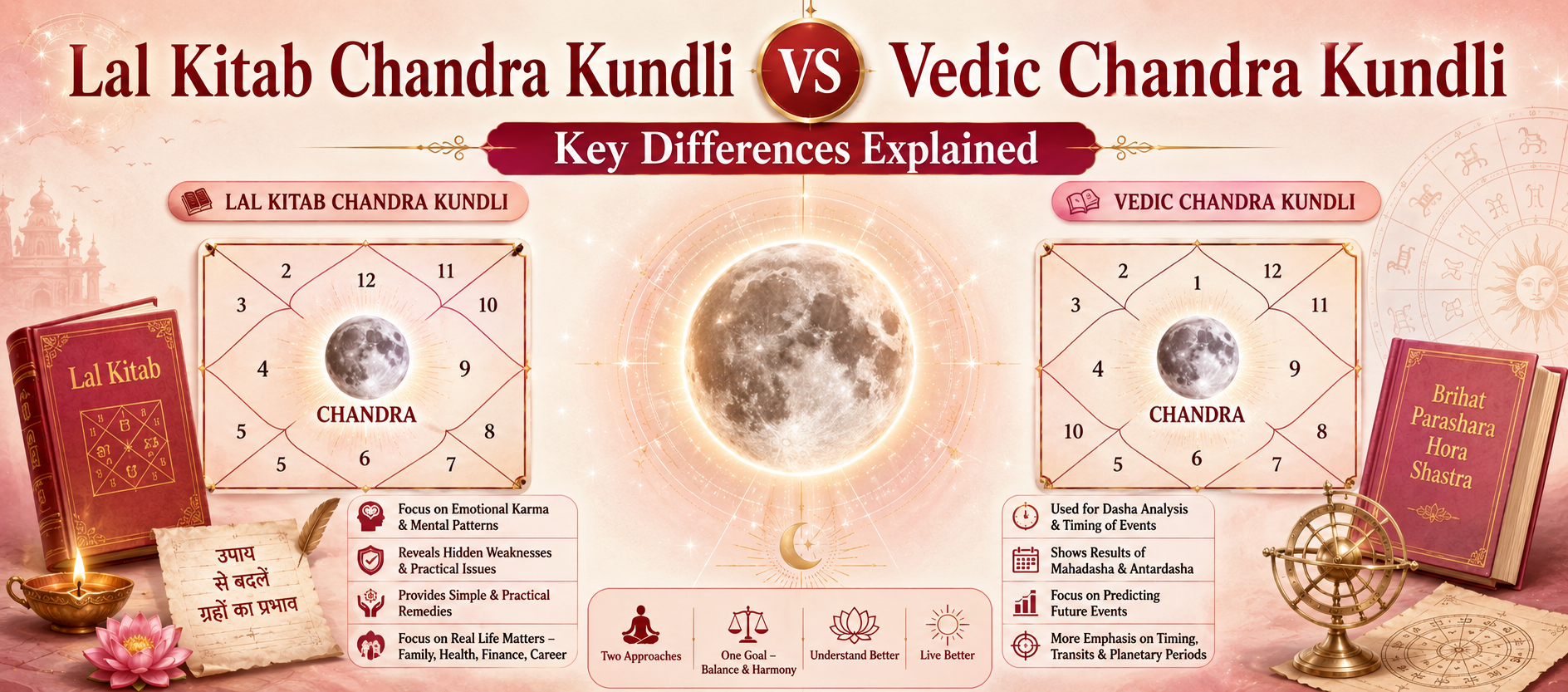
- In Vedic Astrology, the Moon Chart helps astrologers understand how planetary periods like Mahadasha and Antardasha influence a person's emotions, thinking, and life experiences. It explains how the mind reacts when different planets become active.
- Lal Kitab, on the other hand, goes a step deeper. Its Chandra Kundli is used to uncover emotional karma, hidden weaknesses, recurring mental patterns, and the practical remedies that can help balance planetary influences. It helps explain why certain situations repeat in life and how our emotions quietly shape our health, career, relationships, finances, and daily decisions.
When these two Moon Charts are studied together, they offer a much deeper understanding of a person. One explains how life feels from within, while the other helps uncover the hidden emotional patterns and karmic lessons behind those experiences. Together, they don't just improve predictions they help us understand ourselves better.
Lal Kitab Chandra Kundli vs Vedic Chandra Kundli
Most astrology students know that the Moon (Chandra) represents the mind, emotions, habits, memories, and how we react to situations.
But many people get confused because Lal Kitab and Vedic Astrology both use a Moon Chart, yet they are not prepared in the same way.
This small difference completely changes how the chart is interpreted.
If you understand both charts, you won't just know what may happen in life—you'll also understand how a person will experience those events emotionally and what practical remedies can help.
Let's understand both systems step by step.
Why is the Moon So Important?
The Moon represents your inner world.
It shows:
- Your emotional strength
- Mental stability
- Decision-making ability
- Happiness
- Fear and anxiety
- Relationships with family
- Peace of mind
Two people may have the same career success, but one enjoys it while the other remains stressed.
The difference often lies in the Moon.
That is why both Vedic Astrology and Lal Kitab give great importance to the Moon, but they study it from different angles.
What is the Vedic Chandra Kundli (Moon Chart)?
In Vedic Astrology, the Moon Chart is created by making the Moon the First House (Lagna).
The original zodiac signs remain exactly the same.
Only the house numbering changes.
This chart mainly helps astrologers understand:
- Mahadasha and Antardasha results
- Mental experience during planetary periods
- Emotional response to events
- Relationships
- Daily life experiences
- Transit analysis
Think of it like this:
Birth Chart = What happens in life
Moon Chart = How you experience those events emotionally
How to Prepare a Vedic Chandra Kundli
Step 1 Prepare your original Vedic Birth Chart (Lagna Chart).
Step 2 Find the zodiac sign where the Moon is placed.
Step 3 Make that Moon sign the 1st House.
Step 4 Now count the remaining houses from the Moon.
- If the Moon is in Scorpio,
- Scorpio becomes House 1
- Sagittarius becomes House 2
- Capricorn becomes House 3
- Aquarius becomes House 4 ...and continue until House 12
Step 5 Keep every planet in the same zodiac sign. Only the house numbers change.This becomes the Vedic Chandra Kundli.
What is the Lal Kitab Chandra Kundli?
Lal Kitab follows a completely different method.
Instead of changing only the house counting, Lal Kitab prepares a special Moon Chart that follows its own house system.
This chart is mainly used for:
- Emotional karma
- Hidden weaknesses
- Practical life problems
- Family issues
- Financial blocks
- Health patterns
- Planetary remedies
- Behaviour that creates karmic results
It is less focused on timing through Dashas and more focused on understanding why problems keep repeating and how they can be corrected.
How to Prepare Lal Kitab Chandra Kundli
The process is slightly different from the Vedic Moon Chart.
- Step 1 Prepare the original Vedic Birth Chart (Lagna Chart).
- Step 2 Keep the Ascendant (Lagna) exactly the same. Do not change the Ascendant.
- Step 3 Now place the Moon in the 1st House (Ascendant).
- Then reposition all the other planets according to their house positions from the Moon.
- Step 4 Once this new arrangement is ready, locate Aries (Mesha Rashi).
- Step 5 Now begin counting the houses from Aries as House 1. Continue counting until House 12.
- Step 6 The final chart obtained after this process becomes the Lal Kitab Chandra Kundli.
This is the chart Lal Kitab uses for deeper emotional and remedial analysis.
The Biggest Difference
|
Vedic Chandra Kundli |
Lal Kitab Chandra Kundli |
|
Moon becomes House 1 |
Moon is shifted to the Ascendant first |
|
Zodiac signs remain fixed |
Houses are finally renumbered from Aries |
|
Mainly used for Dasha and transit interpretation |
Mainly used for remedies and emotional karma |
|
Focuses on emotional experience |
Focuses on practical correction and karmic balance |
|
Explains how events are felt |
Explains why patterns repeat and how to improve them |
A Simple Example
Imagine two people lose their jobs.
According to the Birth Chart
Both may have the same difficult planetary period.
So the event is similar.
According to the Vedic Moon Chart
Person A remains calm.
Person B becomes anxious, depressed, and loses confidence.
The Moon Chart explains the emotional difference.
According to the Lal Kitab Moon Chart
It may reveal that Person B repeatedly creates conflicts with seniors, avoids responsibility, or has an imbalance related to a specific planet.
Lal Kitab then suggests practical remedies to reduce that karmic pattern.
The event may be the same, but the cause and solution become much clearer.
Another Easy Example
Suppose Venus is creating relationship problems.
Vedic Moon Chart tells you:
During Venus Mahadasha, emotional expectations increase.
The native becomes more sensitive in relationships.
Lal Kitab Moon Chart tells you:
The person repeatedly attracts similar relationship problems because Venus is carrying unresolved karmic imbalance.
The solution is not only understanding emotions but also correcting habits and performing suitable remedies.
Now prediction becomes much more practical.
Why Should We Study Both Charts?
Imagine driving a car.
The Birth Chart tells you where the road is going.
The Vedic Moon Chart tells you how comfortable the journey feels.
The Lal Kitab Moon Chart tells you what mistakes you're making while driving and how to avoid future problems.
When all three are studied together, astrology becomes much more complete.
How Both Charts Help in Better Decision-Making
Using both Moon Charts together provides a broader perspective because they answer different questions:
Vedic Chandra Kundli answers:
- How will I feel during this period?
- Which Mahadasha or Antardasha is emotionally challenging?
- How will transits affect my mind?
- Which relationships need more emotional understanding?
Lal Kitab Chandra Kundli answers:
- Why does this problem repeat?
- Which planet is creating hidden emotional karma?
- Which habits are strengthening negative planetary effects?
- Which practical remedies can reduce these challenges?
When both perspectives are combined, an astrologer can understand the event, the emotional response, the root cause, and the practical solution—making guidance far more balanced and useful.
Final Thoughts
Although both charts are called Chandra Kundli, their purpose is different.
The Vedic Chandra Kundli helps you understand how planetary periods, transits, and life events affect your mind and emotions.
The Lal Kitab Chandra Kundli goes a step further by revealing emotional karma, recurring life patterns, and practical remedies that can help restore balance.
Rather than choosing one over the other, learning to use both together gives a more complete understanding of a person's life. One explains how you experience your destiny, while the other helps uncover why certain emotional patterns repeat and what you can do to improve them. This combined approach allows students and practicing astrologers alike to make clearer predictions, recommend more meaningful remedies, and offer guidance that is both insightful and practical.
FAQs
1. What is the difference between the Vedic Chandra Kundli and the Lal Kitab Chandra Kundli?
The Vedic Chandra Kundli is created by treating the Moon sign as the first house while keeping all zodiac signs fixed. It is mainly used to analyze Mahadasha, Antardasha, planetary transits, and emotional experiences. The Lal Kitab Chandra Kundli follows a different preparation method and focuses on emotional karma, recurring life patterns, hidden weaknesses, and practical remedies.
2. Why is the Moon important in both Vedic Astrology and Lal Kitab?
The Moon represents the mind, emotions, memory, decision-making, and mental stability. Both Vedic Astrology and Lal Kitab consider the Moon essential because it shows how a person experiences life events emotionally, although each system interprets it differently.
3. How is a Vedic Chandra Kundli prepared?
To prepare a Vedic Chandra Kundli, identify the zodiac sign occupied by the Moon in the birth chart and make it the first house. The zodiac signs remain unchanged, but the house numbering is recalculated from the Moon.
4. What does the Lal Kitab Chandra Kundli reveal?
The Lal Kitab Chandra Kundli helps identify emotional karma, recurring challenges, hidden behavioral patterns, financial obstacles, family issues, health concerns, and the most effective Lal Kitab remedies to reduce planetary imbalances.
5. Should astrologers use both Moon Charts together?
Yes. Using both charts together provides a more complete analysis. The Vedic Chandra Kundli explains how planetary periods and transits affect the mind, while the Lal Kitab Chandra Kundli reveals the karmic reasons behind recurring problems and suggests practical remedies.
6. Which Moon Chart is better for predictions?
Neither chart is better than the other—they serve different purposes. The Vedic Chandra Kundli is ideal for timing events through Mahadasha, Antardasha, and transits, whereas the Lal Kitab Chandra Kundli is better for understanding emotional karma, recurring life patterns, and recommending practical remedies. Together, they provide deeper and more accurate astrological guidance.