sun-in-1st-house-lal-kitab-remedy-powerful-dark-room-remedy-and-effects
Sun in 1st House in Lal Kitab Remedy: Why a Dark Room Can Be a Remedy
In Lal Kitab, remedies are not always about wearing a gemstone, donating something or performing a ritual. Some remedies need to be decoded through the behaviour of the planet and its impact on everyday life.
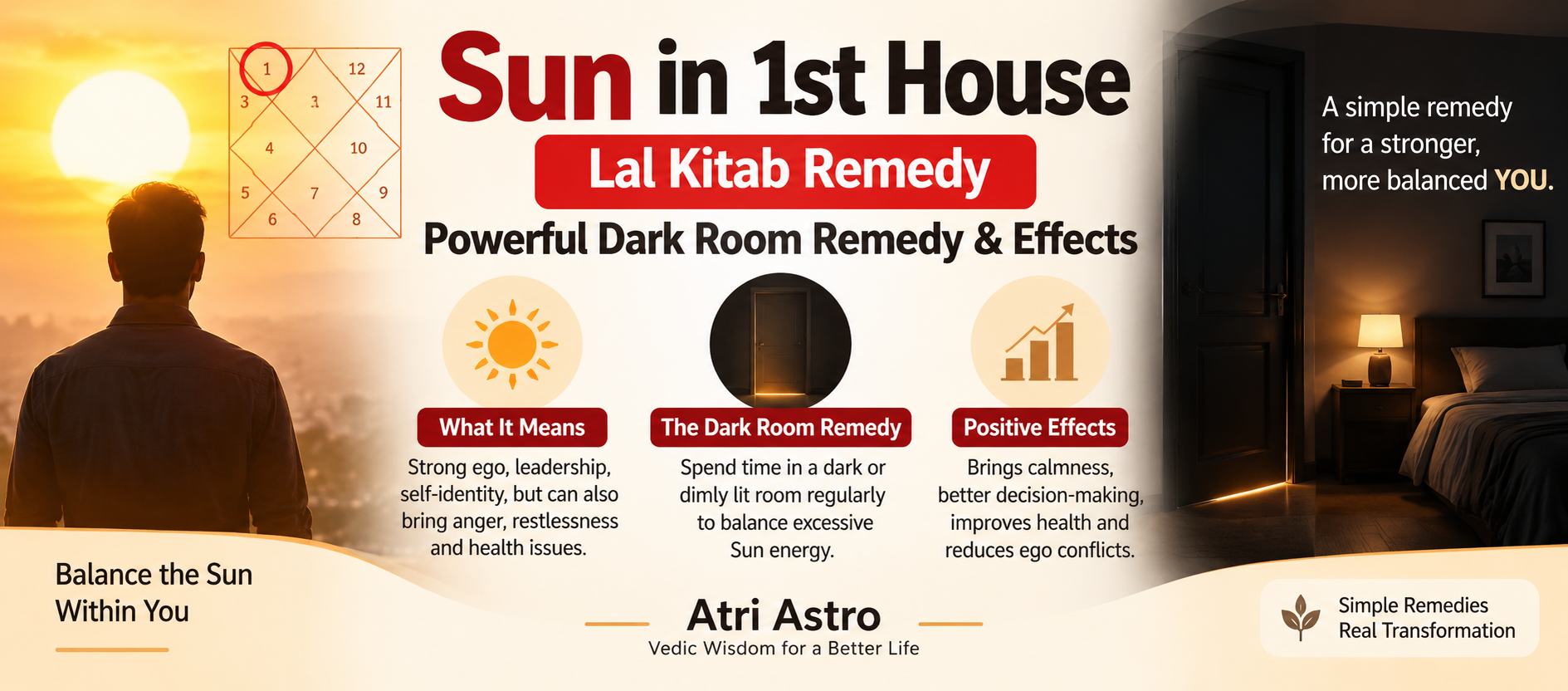
When the Sun is placed in the 1st house, Lal Kitab suggests a very specific remedy: apne makan/house mein right side mein, last corner mein ek dark room banana — in other words, create a dark or dimly lit room on the right-hand side, in the last corner of your own house.
The essence of this Sun Remedy in Lal Kitab is important. It is not simply about having any dark room anywhere in the house. The traditional instruction specifically focuses on your own house, the right side, and the last corner.
One such interesting remedy is suggested by Lal Kitab when the Sun is placed in the 1st house: keeping a dark or dimly lit room in the house where you can sit, relax and spend some peaceful time.
At first, this remedy may sound unusual. After all, the Sun represents light. So why would Lal Kitab suggest creating a dark space for someone who has Sun in the first house?
The answer becomes interesting when we understand the connection between light, the mind, rest and sleep.
Sun in the 1st House and the Need to Switch Off
The first house represents the self, personality, body and the way a person experiences life. When the Sun occupies the first house, solar energy becomes strongly connected with the individual.
This can create a tendency towards being constantly active, alert, involved or mentally switched on. The person may find it difficult to completely switch off and relax.
This is where the remedy needs to be understood—not blindly followed.
The idea is to create a balance between constant stimulation and complete rest.
Therefore, apne makan ke right side ke last corner mein ek dark room rakhna—creating a dark or dimly lit room on the right side, in the last corner of your own house—gives the person a dedicated space where they can withdraw from excessive stimulation, sit peacefully and allow the mind to settle.
Why Darkness Matters for the Mind
There is also a scientific reason behind the practical side of this remedy.
Darkness acts as an important signal for the body's sleep–wake cycle. When the environment becomes dark, the brain recognises that it is approaching the time for rest. This supports the natural release of melatonin, the hormone associated with regulating sleep.
On the other hand, exposure to bright light, especially at night, can interfere with the body's natural melatonin response.
So, when we talk about a dark room in this remedy, the point is not simply “sit in darkness because Sun is in the first house.”
The remedy is about creating a place where the mind receives fewer external signals and can gradually move from an alert state towards a calmer state.
How to Use the Dark Room Remedy
The room does not need to be completely black or uncomfortable.
The important point is that the room should be in your own house, on the right-hand side, in the last corner, as per the essence of this Lal Kitab remedy.
It can simply be a quiet, peaceful and dimly lit space where you can spend some time before going to sleep.
You can:
-
Reduce unnecessary lighting in the room.
-
Keep the environment quiet and peaceful.
-
Spend some time there before bedtime.
-
Avoid excessive screen exposure during this period.
-
Use the room as a space for relaxation rather than work or continuous activity.
-
Keep the sleeping environment sufficiently dark at night.
The purpose is to allow the mind to move from stimulation to relaxation.
This Is Not a Blind Remedy
This is the part that needs to be understood properly.
A Lal Kitab remedy should not always be taken only at its surface level. We need to understand what the remedy is trying to correct or balance.
Here, the logic can be decoded as:
Strong solar stimulation → difficulty switching off → need for reduced sensory stimulation → darkness and calmness → support for the natural sleep cycle.
So the remedy is not about rejecting the Sun or avoiding sunlight altogether.
In fact, sunlight during the daytime is important for maintaining a healthy circadian rhythm. The recommendation is specifically about creating darkness and calmness at the appropriate time, particularly before sleep.
The Deeper Lal Kitab Logic
This is why I consider this an interesting Lal Kitab remedy.
It takes something as simple as darkness inside the house and connects it with the way a person rests, thinks and recovers.
As per Lal Kitab When Sun is strongly influencing the first house, the remedy is not necessarily about suppressing the Sun. It is about giving the individual an opportunity to come out of constant solar alertness and enter a state of rest.
A peaceful dark room can therefore become a practical tool for creating that transition.
The remedy should be understood as a decoded behavioural remedy, where traditional Laal Kitab wisdom is applied through something that can also be understood from the perspective of the body's natural sleep mechanism.
And that is exactly why remedies should not be followed blindly.
Understand the planet. Understand the house. Understand the behaviour. Then understand the remedy.
FAQ – Sun in 1st House Lal Kitab Dark Room Remedy
Q1. What is the Lal Kitab remedy for Sun in the 1st house?
Answer: Lal Kitab suggests creating a dark or dimly lit room in your own house on the right side, in the last corner. This space is meant for peace, relaxation, and reducing excessive mental stimulation associated with a strong Sun in the 1st house.
Q2. Why does Lal Kitab recommend a dark room when the Sun represents light?
Answer: The remedy is symbolic and behavioural. A strong Sun in the 1st house can keep a person mentally alert and constantly active. A dark room helps reduce sensory stimulation, allowing the mind and body to transition into a calmer, more restful state.
Q3. Does the dark room have to be completely black?
Answer: No. The room does not need to be pitch black. It should simply be quiet, peaceful, and dimly lit, creating an environment that supports relaxation, meditation, or spending time before sleep.
Q4. Can I use this remedy in a rented house or apartment?
Answer: The traditional Lal Kitab instruction specifically mentions your own house (apna makan) and placing the dark room on the right side in the last corner. If that exact setup is not possible, the core idea is to create a calm, low-light space that follows the spirit of the remedy.
Q5. What is the deeper meaning of the Sun in 1st House Dark Room Remedy in Lal Kitab?
Answer: The deeper logic is to balance strong solar energy rather than suppress it. During the day, sunlight supports health and vitality, but before sleep, darkness helps the brain release melatonin and supports the body's natural sleep cycle. Lal Kitab uses this remedy as a behavioural way to restore balance between activity and rest.