Sun in 1st House Lal Kitab Remedy: The Hidden Logic of Jaggery Donation Nobody Explains
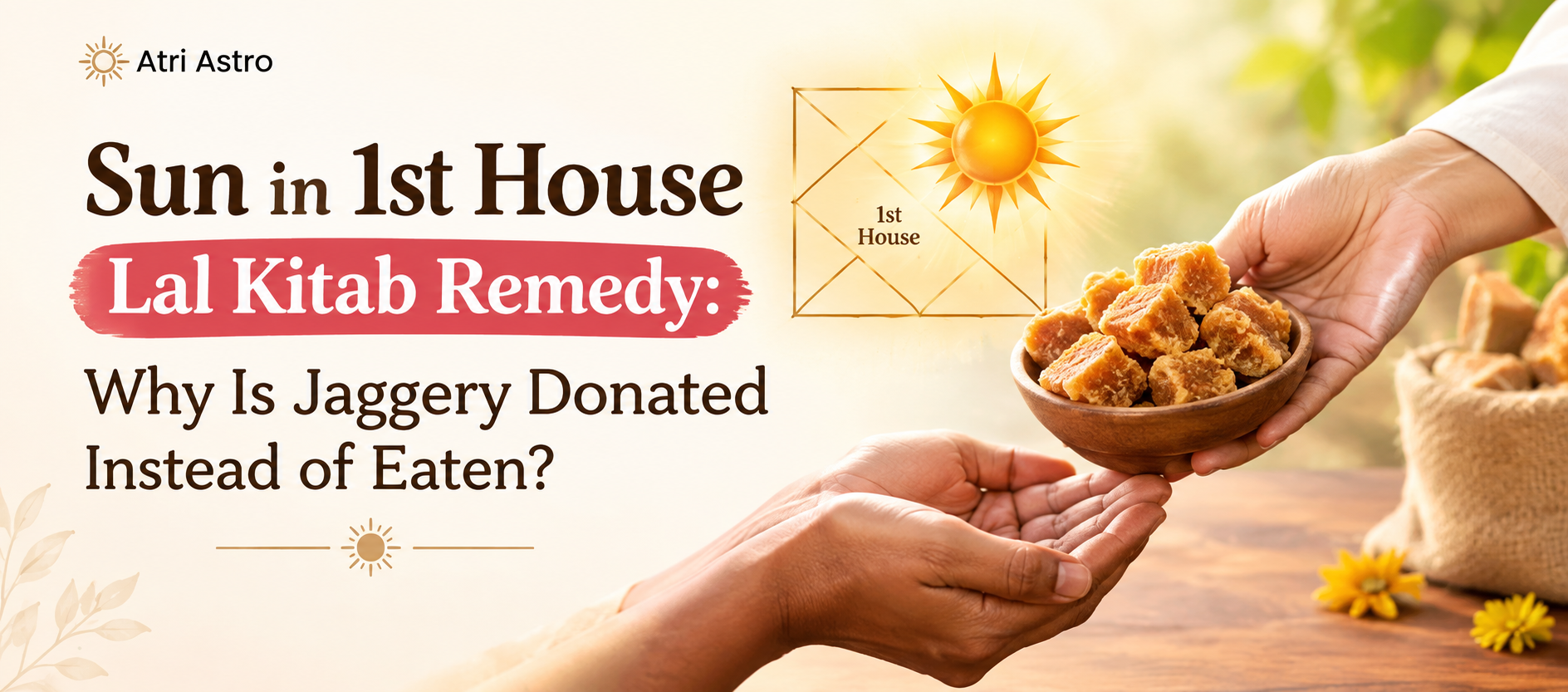
Sun in 1st House Lal Kitab Remedy: Why Is Jaggery Donated Instead of Eaten?
“Agar Sun 1st house mein ho to gur yani jaggery daan kare.”
This simple line captures one of the traditional Lal Kitab remedies for Sun in the 1st house.
But an important question comes next: Why is jaggery donated instead of eaten?
To understand this traditional remedy, we need to look at the relationship between the Sun, jaggery (gur), Vata, Pitta, and the action of donation.
Sun in 1st House in Lal Kitab
In astrology, the 1st house represents the self, personality, physical vitality, confidence, identity, and overall strength.
The Sun is traditionally associated with fire, vitality, energy, confidence, inner strength, and life force.
When the Sun is placed in the 1st house, these themes become especially significant in the Lal Kitab approach.
This is why a Sun in first house remedy is not simply about following a ritual. Lal Kitab remedies are traditionally understood through the relationship between a planet, a substance, and the action performed with that substance.
What Is the Connection Between Jaggery and the Sun?
Jaggery, commonly known as gur, has a traditional place in Ayurveda and Indian remedial practices.
In the traditional Ayurvedic framework, jaggery is associated with qualities that may support Vata balance, while it is also traditionally described as having a relationship with Pitta and heat depending on its qualities, quantity, and context.
Pitta is associated with the fire principle, transformation, heat, and metabolic activity.
The Sun, meanwhile, is strongly connected with fire, vitality, energy, and inner strength in astrological symbolism.
This traditional relationship forms part of the reasoning used to understand why jaggery is handled differently as a remedy when the Sun is in the 1st house.
Why Is Jaggery Donated Instead of Eaten?
Eating jaggery increases Pitta, or the fire element. Therefore, when we understand this through the principles of Lal Kitab, if the Sun is in the 1st house, the Sun is already strong and the fire element is already dominant.
If such a person consumes jaggery, it may further increase Pitta/fire. This is why, instead of consuming jaggery, donating jaggery is recommended as a remedy.
This is the central idea behind the traditional jaggery remedy Lal Kitab.
The instruction is:
Agar Sun 1st house mein ho to gur yani jaggery daan kare.
In other words, when jaggery is being used specifically as a Lal Kitab remedy, the traditional recommendation is to donate it rather than consume it as the remedial action.
The distinction is simple:
Eating → You consume the substance yourself.
Donating → You offer or give the substance away.
Therefore, the remedy is not simply saying, “Do not eat jaggery.”
It is about how jaggery is used within the remedial practice.
Jaggery Remedy Lal Kitab: Understanding the Principle
The traditional jaggery remedy Lal Kitab can be remembered through four connections:
Jaggery (Gur) → traditionally associated with Ayurvedic dosha concepts
Pitta → associated with fire, heat, and transformation
Sun → represents vitality, energy, fire, confidence, and inner strength
1st House → represents the self, personality, vitality, and physical constitution
This gives a simple framework for understanding the traditional Sun and jaggery in Lal Kitab connection.
Why Donation Rather Than Consumption?
The action of a remedy is important in Lal Kitab.
A remedial substance is not always meant to be consumed. In traditional remedial thinking, giving, donating, offering, keeping, or using a substance in a particular way can have different symbolic meanings.
For Sun in the 1st house, jaggery is traditionally recommended as something to donate rather than consume as a remedy.
Therefore, the focus is on the act of donation, rather than treating jaggery simply as a food item.
This is also why the line:
“Agar Sun 1st house mein ho to gur yani jaggery daan kare”
is useful to remember when studying this traditional Lal Kitab principle.
Why Not Follow the Remedy Blindly?
Lal Kitab becomes easier to understand when we study the reasoning behind a remedy instead of memorising isolated instructions.
Rather than thinking:
“Sun 1st house mein hai, isliye gur nahi khana.”
The better learning approach is:
Understand the planet → understand the substance → understand the action → apply the remedy consciously.
This approach helps students understand the logic and symbolism behind traditional remedies.
Why Donate Jaggery for Sun?
In Lal Kitab, remedies are meant to balance a planet's energy, not strengthen it unnecessarily. When the Sun is placed in the 1st house, its fiery nature is already prominent. Since jaggery is considered to increase Pitta or the fire element, eating it may amplify this energy further.
That is why Lal Kitab recommends donating jaggery instead of consuming it. The remedy is about reducing excess fire through the act of donation, helping bring the Sun's energy into balance rather than adding more heat to it.
The question “Why donate jaggery for Sun?” can therefore be answered simply.
The traditional interpretation connects:
Sun → fire, vitality, energy
1st house → self and vitality
Jaggery → traditional Ayurvedic and remedial associations
Donation → the prescribed remedial action
Therefore, in the traditional Lal Kitab approach, jaggery is donated rather than eaten as a remedy when the Sun is in the 1st house.
Is This a General Rule About Eating Jaggery?
No.
This distinction is important.
The traditional Lal Kitab remedy for Sun in 1st house should not be interpreted as a universal dietary or medical prohibition against eating jaggery.
If someone asks, “Can you eat jaggery if the Sun is in the 1st house?”, the answer depends on what is being discussed.
As a food, jaggery is not automatically prohibited simply because the Sun is in the 1st house.
The traditional Lal Kitab instruction discussed here specifically concerns using jaggery as a remedial measure, where donation is recommended instead of consumption.
The Simple Lal Kitab Remedy for Sun in 1st House
Remember the remedy through this simple chain:
Sun in 1st house
↓
Sun represents fire, vitality and energy
↓
Jaggery has traditional Ayurvedic and remedial associations
↓
Donation is prescribed as the remedial action
↓
Agar Sun 1st house mein ho to gur yani jaggery daan kare.
This makes the remedy easier to remember and understand rather than treating it as a blind rule.
Frequently Asked Questions
1. Why is jaggery donated instead of eaten in Lal Kitab?
According to the traditional Lal Kitab approach, jaggery is donated rather than eaten as a remedy when the Sun is in the 1st house. The recommendation is based on the traditional relationship between the Sun, jaggery, elemental qualities, and the remedial action of donation.
2. Why should jaggery be donated for Sun in the 1st house?
The traditional Sun in 1st house Lal Kitab remedy recommends donation because the remedial practice focuses on giving jaggery away rather than consuming it. This is understood through the traditional symbolic relationship between the Sun and the qualities associated with jaggery.
3. Can you eat jaggery if the Sun is in the 1st house?
The jaggery remedy Lal Kitab is specifically about using jaggery as a remedy. The traditional recommendation is to donate jaggery rather than eat it for remedial purposes. It should not be understood as a general medical or dietary restriction.
4. What is the Lal Kitab remedy for Sun in the first house?
One traditional Lal Kitab remedy for Sun in the first house is to donate jaggery instead of consuming it as a remedial measure. Other remedies may be considered depending on the complete horoscope and the specific planetary conditions.
5. What is the connection between Sun and jaggery in Lal Kitab?
The traditional Sun and jaggery in Lal Kitab connection is understood through their symbolic and elemental associations. The Sun represents fire, vitality, energy, and inner strength, while jaggery has traditional Ayurvedic and remedial associations. Donation is prescribed as the remedial action in this context.
6. What is the jaggery remedy for Sun?
The traditional jaggery remedy for Sun is to donate gur rather than consume it as a remedial practice when the Sun is in the 1st house.
7. What are the Lal Kitab Sun remedies for Surya in the 1st house?
Lal Kitab Sun remedies can vary according to the complete horoscope. For Sun in the 1st house, donating jaggery is one traditional remedy. A complete chart should be considered before applying multiple remedies.
8. Why is jaggery considered unsuitable to eat as a remedy for Sun in the 1st house?
In the traditional Lal Kitab interpretation, the issue is not that jaggery is universally unsuitable as a food. Rather, when jaggery is being used specifically as a remedy for Sun in the 1st house, the traditional instruction is to donate it instead of consuming it as the remedial action.
Final Thought
The deeper value of Lal Kitab remedies lies not only in knowing what to do, but also in understanding why a particular action is recommended.
For Sun in 1st house Lal Kitab, the traditional jaggery remedy is centred on the relationship between the Sun's fiery symbolism, the traditional associations of jaggery, and the act of donation.
So, if you want one line to remember this remedy:
“Agar Sun 1st house mein ho to gur yani jaggery daan kare.”
It is a simple traditional Lal Kitab instruction—but understanding the reasoning behind it makes the remedy easier to learn, remember, and apply consciously.
Note: This article presents a traditional Lal Kitab and Ayurvedic interpretation. It is not a medical, nutritional, or scientifically established rule, and astrological remedies should not replace professional medical or dietary advice.